Same Lake, Different Boat

“difficulty is a normal part of life in an abnormal world.” -Stephanie O. Hubach

We live in a fallen world. As much as we may try to keep this reality at bay, it is evident in our culture, current events, and even in ourselves. Since we all bear God’s image, unbelievers also recognize things are not as they should be. They seek to create a human utopia through climate change, man’s sense of justice, or any other philanthropic endeavor to turn the world’s axis right again. Others may bend under resignation, with a fatalistic mentality, and live just for themselves- eat, drink now and be merry.

But neither of those options are any good. Mere outward reform and indulgence are fleeting. As Christians, God calls His people to engage others while still trusting in His Sovereign plan. “He has showed you, O man, what is good. And what does the Lord require of you? To seek justice, love mercy and to walk humbly with your God” (Micah 6:8). How are Christians living out this mandate right in their own backyard? It can take many forms because the needs around us are many, as we experience life in a broken world. Believers are called to be Spirit-led when serving, as God directs our hearts in the work He has prepared for us (Ephesians 2:10). All Christians are called to be the hands and feet of Christ in whatever capacity, gifts and ability God has given them.

In her book Same Lake, Different Boat, Stephanie O. Hubach argues for the Church to recognize the need for ministering to the disabled. Disability is a broad term which includes physical, intellectual, developmental, mental or sensory. Under this umbrella consist people with autism, blindness, deafness, spina bifida, Down syndrome, multiple sclerosis and cerebral palsy, to list a few. Besides the fact that God commands us to care for the least of these, meaning those who require the help of others long term or short term, one might ask, “What does this have to do with me?”

Before my son was born, the special needs world was not on my radar. It wasn’t that I didn’t care, it just didn’t affect me personally, nor did I know many people who were disabled. Then the Lord lovingly assigned it to me. Now I see a need which mostly flies under the radar, because those with disability typically need an advocate. Advocacy normally falls on the parents or caregivers, who already have a limited supply of energy and time. Their net covers just the one in their care, not spreading out to the larger disabled group. This is a great opportunity for outside help, particularly in the Church. Back to the question, “What does all this have to do with me?” Well, when we remember our own brokenness and the free grace which has been lavished on us, it should prompt every Christian to turn around and offer acts of mercy to a hurting world. We tell others the Gospel by also showing it to them. Hubach puts it this way:

The first thing that motivates us to identify with others is a proper perspective of ourselves. “Do not think of yourself more highly than you ought” (Romans 12:3). We must recognize that we all have needs- that is a normal part of life in an abnormal world. Our brokenness and vulnerability as humans is universal; how it manifests itself is variable. Same lake, different boat.”

Just as Christ acted on behalf of every redeemed sinner in the most monumental, supernatural work of atonement, Christians are called to serve others sacrificially, although imperfectly.

If you agree that Christians have a responsibility to bless and serve the overlooked or forgotten, but don’t know how to help, here are a few suggestions. A good starting point is in your local church. Is there a Sunday school class offered for special needs that you can help with? Or perhaps there is a need for care during the main worship? Some with special needs may not be able to sit for an entire service, or will make involuntary disruptions such as noises or hand flapping. This can cause the entire family to feel self-conscious, not to mention distracted as they try to participate in the service, while keeping their loved one quiet. What a blessing to be able to minister to the family by providing a space where their loved one is cared for, so they can focus on the sermon and receive spiritual nourishment.

Another way to minister to someone with a disability is to look in your community. There are care facilities and special needs sports/art/music/camp programs which I’m sure would love more volunteers. I have found over the years that I receive possibly more encouragement than the ones I attempt to serve when taking part in the special needs world.

Although the building itself is not the church, but the people inside it, the structure of a church can be very beneficial in welcoming those with special needs. Does your church facility accommodate those with disability by making the entrance handicap accessible, providing a family restroom for diapering needs, or have an unused quiet room for when a sensory overload meltdown occurs? Are these things in place or do they need to be implemented? The way a church does or does not provide accommodations speaks volumes on whether the welcome mat is laid out for special needs or pulled up tightly. A church can unknowingly act like a country club by passively excluding those who are different, or make its members uncomfortable. The function of a church operates out of its particular culture in what it values, not what it says it values, but actually does.

Are there persons with special needs who regularly attend your church? Are they an integral part of the body or kept on the fringe? Is your church missing this vital role? Please don’t misunderstand the reason for this post. My goal is not to pile on a guilt trip. These are however, good questions to consider by bringing awareness in an area of ministry that might need attention. What a great opportunity the church has to show the love of Jesus to this particular group. We are made up of the body of Christ and need each part. “The eye cannot say to the hand, “I don’t need you!” And the head cannot say to the feet, “I don’t need you!” On the contrary, those parts of the body that seem to be weaker are indispensable, and the parts that we think are less honorable we treat with special honor. And the parts that are unpresentable are treated with special modesty, while our presentable parts need no special treatment. But God has combined the members of the body and has given greater honor to the parts that lacked it, so that there should be no division in the body, but that its parts should have equal concern for each other” (1 Corinthians 12:21-25).

A word of encouragement to someone who feels intimidated in serving people with disability. That’s okay and I think normal. Those who take the care of others seriously will have a bit of trepidation. We don’t want to add to their burden by our ignorance in how their medical equipment works, or how difficult it might be to relate. I have no educational background in special needs. I’m just a mom who knows her son. The vast spectrum of disability and my lack of knowledge overwhelms me too! But here’s the good news. We don’t have to do any of these things in our own strength. That isn’t just a pretty little saying, but absolutely true to those who claim it by faith. God will give wisdom and help as we ask for it. The needs will vary in a case by case situation, but God has promised to provide the grace and strength we need for this day, to carry out the work He has given us for this day. With that said, it is my hope that those with a disability and their families will be gracious receivers, knowing we are imperfect and may not get it right the first time.

Ministering to those with special needs is an opportunity to become more prayerful and Christ dependent, rather than go rogue and seek only outward reform. The point of inclusion for special needs families is ultimately to point them to Christ, just like everyone else. This is the heart need every soul longs for. Do they belong too?

Stephanie O. Hubach’s book Same Lake, Different Boat has greatly ministered to me. She is a parent of two boys, one with Down syndrome. Hubach has insight, practical wisdom and Biblical encouragement, beneficial for every Christian whether you are directly affected by special needs or not. As Christians we are called to come alongside those who are in need, like those touched by disability. I appreciate how Hubach does not come across as demanding, angry or self-pitying in her experience and analysis. She shoots straight with a heart of compassion and a dose of humor.

We are solution oriented people. If something cannot be fixed or improved upon, our tendency is to shy away instead of lean in. It is not wrong to try and make things better. As image bearers, one aspect of this is healing. But the kind of healing Christians can most meaningfully co-labor with God in is spiritual. We bless others when we truly see them with dignity as fellow image bearers. We likely cannot fix the visible disability, but we can be a friend. Believers can demonstrate the Gospel by speaking up for the weak, serving in kindness, laced with humility toward those the world does not highly value.

Hubach speaks of the worth of each person as the starting point to understand the reason we serve others by saying,

When the image of God within is central to our understanding of humanity, it sends a powerful message about human value to the world around us. Our culture often measures personal value as a function of productivity. The degree to which we are able to contribute to society is the degree to which we are valued. In God’s economy, however, human value is defined by the Creator Himself through the imprint of His image in humankind. Others take notice, not merely when we say this is true, but when we live like it is true in respect-based relationships. Our actions ought to declare, “You are incredibly valuable!” to everyone we meet.

In the same way, the powerful message of the gospel is demonstrated when we respond to others in grace-based actions. Our competitive culture is uncomfortable with weakness. When people see us acknowledge our frailties and intentionally engage others in the areas of their brokenness, we live out the gospel of grace in powerful ways.

This kind of service bears fruit that is pleasing to God. This kind of healing when God is at work is of eternal value. May God direct all of our hearts in His love as we do His kingdom work, persevering in His strength.

Grace upon grace,

April

Here is a helpful link in understanding the statistics of children and adults with special needs in the Church, as well as how their families are impacted.

Growing deeper: Matthew 25:31-46; Romans 12:1-16; 1 Corinthians 12:12-26; Proverbs 3:5-6; 2 Thessalonians 3:5

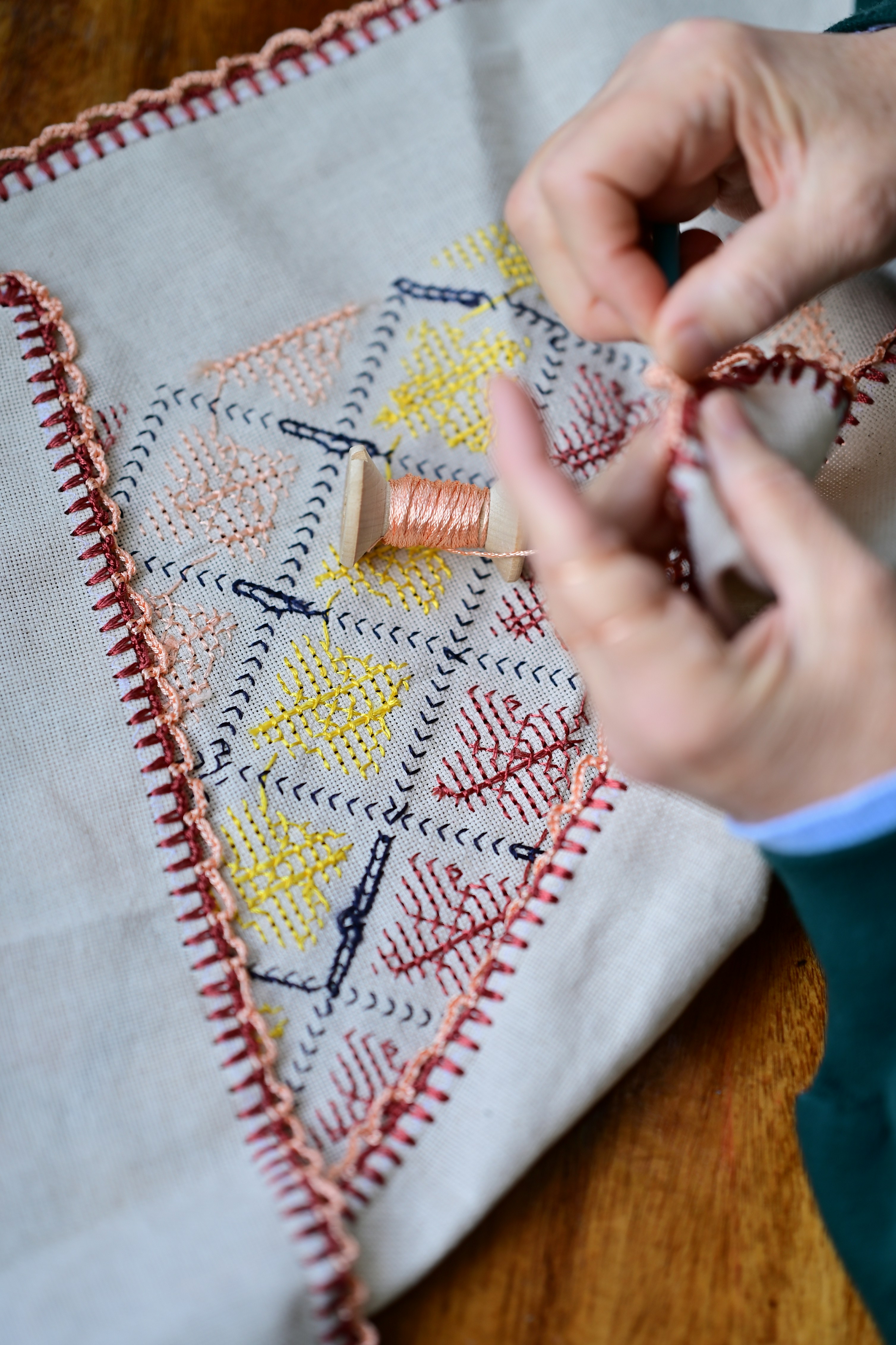
The Tapestry Poem

I’ve heard this poem before and recently read it in the Epilogue to ‘The Hiding Place’ by Corrie ten Boom. The poem is called, “My Life Is Like a Weaving” by Grant Colfax Tullar. I hope it blesses you too.

My life is like a weaving

between my God and me.

I do not choose the colors

He works steadily.

Sometimes He weaves sorrow

and I in foolish pride

forget He sees the upper,

and I the underside.

Not till the loom is silent

and the shuttles cease to fly

will God unroll the canvas

and explain the reason why

the dark threads are as needful

in the skillful weaver’s hand

as the threads of gold and silver

in the pattern He has planned.

Our understanding is finite, His is infinite. We were never in control, God is Sovereign over all. He is perfect in love, we love imperfectly. Given the comparison in character traits, we are better off trusting the Lord with His plans for us rather responding in fear, anger or bitterness.

When WWII began in Corrie ten Boom’s city of Haarlem, the dogfighting in the sky kept her and her sister Betsie awake. They decided to go downstairs in the middle of the night for a cup of tea to calm their nerves until it was over. Finally, Corrie made her way back upstairs to her bedroom where she felt in the dark something sharp on her pillow. It was a 10 inch piece of shrapnel from the night bombings. She ran back to her sister and showed her in terror, what had been laying on her pillow. “What if I had still been in bed?!” Corrie exclaims. Betsie assured her there are no “what ifs” in God’s plan. Whatever He purposes for us, good or bad, we are safest when we are in the center of His will.

As the war progressed the ten Booms would later be arrested for hiding Jews in their home. The horrors of their experience in concentration camps are told in Corrie’s book ‘The Hiding Place’. From these events, she learns to forgive the humanly speaking, unforgivable acts of the Nazis. She even learns to love her enemies, setting up several homes after the war, as a rehabilitation center for those not ready to face the world yet. Corrie went on to travel the world telling others the love of God through the gospel of Jesus Christ.

She likely would not have chosen the tapestry of sorrow and loss weaved into her life, but God sees the overall picture. He took what was meant for evil and used it for good. Everything the Lord does, throughout all of history, has always been for His glory. Elisabeth Elliot once noted, “It is not what the Lord is doing TO you, but rather, what the Lord is doing FOR you.” Whatever He purposes for us in this life serves as an opportunity to refine our character into Christlikeness, and untether us from this temporary world. Author Sam Wellman who wrote the Epilogue to ‘The Hiding Place’ says, “Love triumphs over all afflictions. Our earthly sufferings only serve to make that which awaits us an even greater glory.”

Grace upon grace,

April

Conversation Starters

A boy in my son’s class invited him to a birthday party recently. I bought a gift and marked the time/date on my phone calendar. The day of the party we arrived to find a few of his classmates in attendance, which I silently felt relieved that we would know at least a couple of the other party guests. He immediately ran to a girl in his class, who is Hispanic. Like him, she is also autistic with low verbal skills. I had never met her parents before since she rides the bus. Other parents who pick up their children after school usually congregate outside the building under an awning. After almost a year, I became acquainted with a few of them.

I walked up to introduce myself to the girl’s parents and was surprised that they knew very little English. In fact, the mother could say maybe five words in English, leaving her husband to do most of the interpreting which was shaky at best. All I could think about was how this couple must have a hundred questions related to their daughter’s school. I could not imagine how lonely it must feel to live in a foreign country, not knowing the language, while navigating/advocating their child’s special needs education!

We attempted a couple of times to talk but the few Spanish classes I had in high school and college completely evaporated from my brain. Knowing how to count to 20 in Spanish or recite the months of the year was not very helpful in the moment. I wanted to communicate with the mother and by the expression on her face I think she did too. She showed me a picture of their other child and I smiled back. We were reduced to facial expressions and pictures. My heart hurt for her and their family.

lightstock_353593_download_medium_april_box_

Then it occurred to me that my son might feel isolated in a similar way. I have wanted so desperately to communicate with him that it is easy to forget how he must feel too. A book I just read from an autistic boy’s perspective called The Reason I Jump by Naoki Higashida gave me a little more insight and sympathy on this. At thirteen, Naoki transcribed in Q&A form using an alphabet grid with the help of his mother and teacher. The book was later translated into English and has become a national bestseller. I definitely don’t agree with his New Age beliefs sprinkled throughout the pages but the core idea I took away from reading it was that we sometimes limit those who aren’t just like us. Whether it is a language barrier, intellectual, or physical, we often view them as less than the rest of us. Instead of learning what life is like in someone else’s shoes we are quick to treat the disabled or disadvantaged with less respect than someone we can relate to.

lightstock_347701_download_medium_april_box_

I still do this on occasion to him when we struggle to communicate or when he can’t calm down or because bath/bedtime makes him super hyper and giggly. The underlying fact is, when I don’t understand his speech or behavior I’m tempted to give up because we aren’t speaking the same language. It can be exhausting and frustrating. Yet I wonder how many times people with Autism or any other barrier are quickly dismissed because the ability to communicate easily is absent. We assume that there isn’t another way or that the case is hopeless. Reading this book gave me a different perspective, and for the first time, hope. Just because my son can’t speak in complete sentences like other children his age doesn’t mean he lacks intelligence or is less of a person. Naoki says,

“One of the biggest misunderstandings you have about us is your belief that our feelings aren’t us subtle and complex as yours. Because how we behave can appear so childish in your eyes, you tend to assume that we’re childish on the inside, too. But of course, we experience the same emotions that you do. And because people with autism aren’t skillful talkers, we may in fact be even more sensitive than you are. Stuck here inside these unresponsive bodies of ours, with feelings we can’t properly express, it’s always a struggle just to survive. And it’s this feeling of helplessness that sometimes drives us half crazy, and brings on a panic attack or meltdown.” (p. 109)

 IMG_0778IMG_0801

I imagine it might be like someone in a coma who can’t respond verbally or physically but can hear everything going on around him perfectly. His senses are a little thrown off, but mentally the coma patient can comprehend his auditory surroundings. Often doctors, relatives, and visitors talk over the patient as if he isn’t even there.

I’m learning to slow down and intentionally communicate with my son – mostly to understand him but also to treat him like I would anyone else without a disability. He’s only six so there will still be wisdom needed (and grace) for training and discipline because I often don’t know exactly what his level of comprehension is. But I don’t want to limit his abilities either. Sometimes that means pushing him a little, to gain confidence. Other moments are more grace-filled and tender, realizing he doesn’t have that specific skill-set yet. But it’s a start in the right direction. Conversation can happen in many forms, not just verbally. For us it looks like a smattering of sign language, spelling words out, hand gestures, pictures and one to two word phrases. We get by. And I am learning that I can’t put him in a box, because he always surprises me by refusing to stay in the mold that society has placed on him.

Grace upon grace,

April

The Life We Never Expected

         img_6724

          The Life We Never Expected by Andrew and Rachel Wilson is an honest confession inside a home with two special needs children – both have different forms of autism. The Wilsons write about real life experiences mingled with sadness and hope. They taught me that it is okay to grieve the dreams I had envisioned for my son; the things all parents look forward to for their kids: little league sports, college, independent living, marriage and grandchildren. Some of those may eventually come true, but right now a typical life is not one of them.

Andrew, a pastor in the UK, is transparent with his own struggles, coming to terms with the life he never expected. All the “big” ministry opportunities he envisioned, traditional parenting, and a regular life, was thrown out the window. Rachel writes in a vulnerable voice, acknowledging that this is hard and messy; but they find moments of humor and sweetness too.

Having a child with any kind of disability is isolating. I feel like I’m in a foreign land most days, unable to relate to another parent’s struggles because we are on completely different plains. When I’m not in the right mindset seeing my son’s typical peers wrecks me. This book has been a lifeline to help me remember that I am not alone. Sleepless night after night? Yes. Multiple therapy appointments? Yes. Hyperactivity, missed social cues, and seizures? Yes, yes, yes. Sometimes it’s comforting to identify with someone else going through a similar situation. I highly recommend this book as an oasis for any parent with a special needs child. Furthermore, family, friends, and the church can glean a helpful inside look on what daily life is like in upside down parenting.

The hope Andrew and Rachel possess as believers is contagious. They live with a mindset focused on eternity – in a world free from autism, epilepsy, wheelchairs, tube feeding, or any kind of suffering. One day their precious children (and mine) will have fully functioning minds where normal conversation is possible. One day they will be finally and completely healed. The Wilsons have given me a breath of fresh air with their raw and truthful words. For that I am grateful.

Here is an excerpt from Rachel:

“We are, at best, sailing desperately into the fog, with ever-changing winds, choppy waters, blank maps, and no real idea what we’re doing.

But God is the Captain. He is the navigator, mapmaker, and expert […] as uncertain as our voyage is, there are solid landmarks ahead that are knowable and concrete because of the Captain.

[…] I know He will journey with us to the very end, at which point everything that is perishable and incomplete will be gloriously resurrected and healed.

So I fix my eyes, not on what is seen but on what is unseen. And I take a deep breath.” (p. 148)


Grace upon grace,

April


The Last Battle

471013925     There are some books that come at just the right time for me to read or re-read. They have great impact and staying power as I linger over the substance weeks after I’ve finished the book. Usually they are books of encouragement and inspiration. It is a bonus if the book is fiction filled to the brim with imagination. One such author who can do that is C.S. Lewis.

I am a C.S. Lewis fan, specifically for his beloved children’s series The Chronicles of Narnia. Every year I pick up a few of the books to read through just for fun. There are seven total. This month I enjoyed reading “The Last Battle” that is the final installment in the series. Some argue book one, “The Magician’s Nephew” should be read last and not first but I prefer to stick to the sequential order (rule follower: guilty as charged). If you have never read The Chronicles of Narnia series I recommend starting at the beginning and work your way through.

I was a little surprised how much I loved this book since the last time I read it because it used to be my least favorite. Lewis beautifully parallels the Christian life to the world of Narnia. The Pevensie children, Digory, Polly, Eustace, and Jill lead similar adventures like Christian in Pilgrim’s Progress. Aslan, the Great Lion, serves as the Christ figure and he physically appears in and out of the books, as needed, but the belief in him always remains. Just like the fingerprints of God are revealed in our stories, so it is with Aslan over Narnia. His supernatural presence is always there even when he is not.

In “The Last Battle” the setting takes place during the last days of Narnia. Perhaps that is why I picked up this book in particular because it feels like we’re living in the last days of Sodom and Gomorrah right now. From chapter one we learn that a deceitful, wicked ape named Shift decides to create his own Aslan with the help of an ignorant easily deceived donkey called Puzzle. Puzzle becomes the puppet for Shift posing as the great lion himself. (False prophets anyone?)

The Narnians, who are mostly talking animals and mythical creatures, follow blindly out of fear or because they truly believe they are obeying Aslan’s orders. The majority of them do this despite the contradictions they see in Aslan’s character, what little they know of him or have been taught. Their hope, knowledge, and faith in the true Aslan is not firm, therefore the Narnians are easily swayed.

So I won’t give the whole book away, I’ll just hit the highlights of my favorite parts of the book. Namely, the last few chapters where Lewis opens the doors to the new Narnia are mesmerizing. It alludes to Heaven. Just even the teeniest tiniest insight to what that might be like is wonderful to meditate on. Lewis brings a simple understanding to how this world is but a faint copy of what is to come. Heaven already exists even though we cannot physically see it yet, so this earth foreshadows something even greater.

One day our faith will be made sight and I believe our senses will not even be able to handle it as we fall flat on our faces, so unworthy, but accepted and loved by God. The comforting theme I take away from “The Last Battle” is that this world is not our home and this is not the end, just the beginning. This is where our salvation and sanctification occur but the actual life we have belongs in Heaven. The writer of Hebrews says the men and women of faith who have gone before us “admitted that they were aliens and strangers on earth […] Instead, they were longing for a better country- a heavenly one. Therefore God is not ashamed to be called their God, for He has prepared a city for them” (Hebrews 11:13d; 16).

When we become discouraged because the earth is worn out, people revel in wickedness, and believers are left weary, take heart friend. The battle has already been won for us. This is how the narrator describes the ending to the story and coincidentally a summation of what believers can look forward to as we wait in eager expectation for what is to be:

“And for us this is the end of all the stories, and we can most truly say that they all lived happily ever after. But for them it was only the beginning of the real story. All their life in this world and all their adventures in Narnia had only been the cover and the title page: now at last they were beginning Chapter One of the Great Story which no one on earth has read: which goes on forever: in which every chapter is better than the one before” (228).

Grace upon grace,

April